The month an agency actually runs
Start to finish, in the order it happens. Not a feature list — the work.
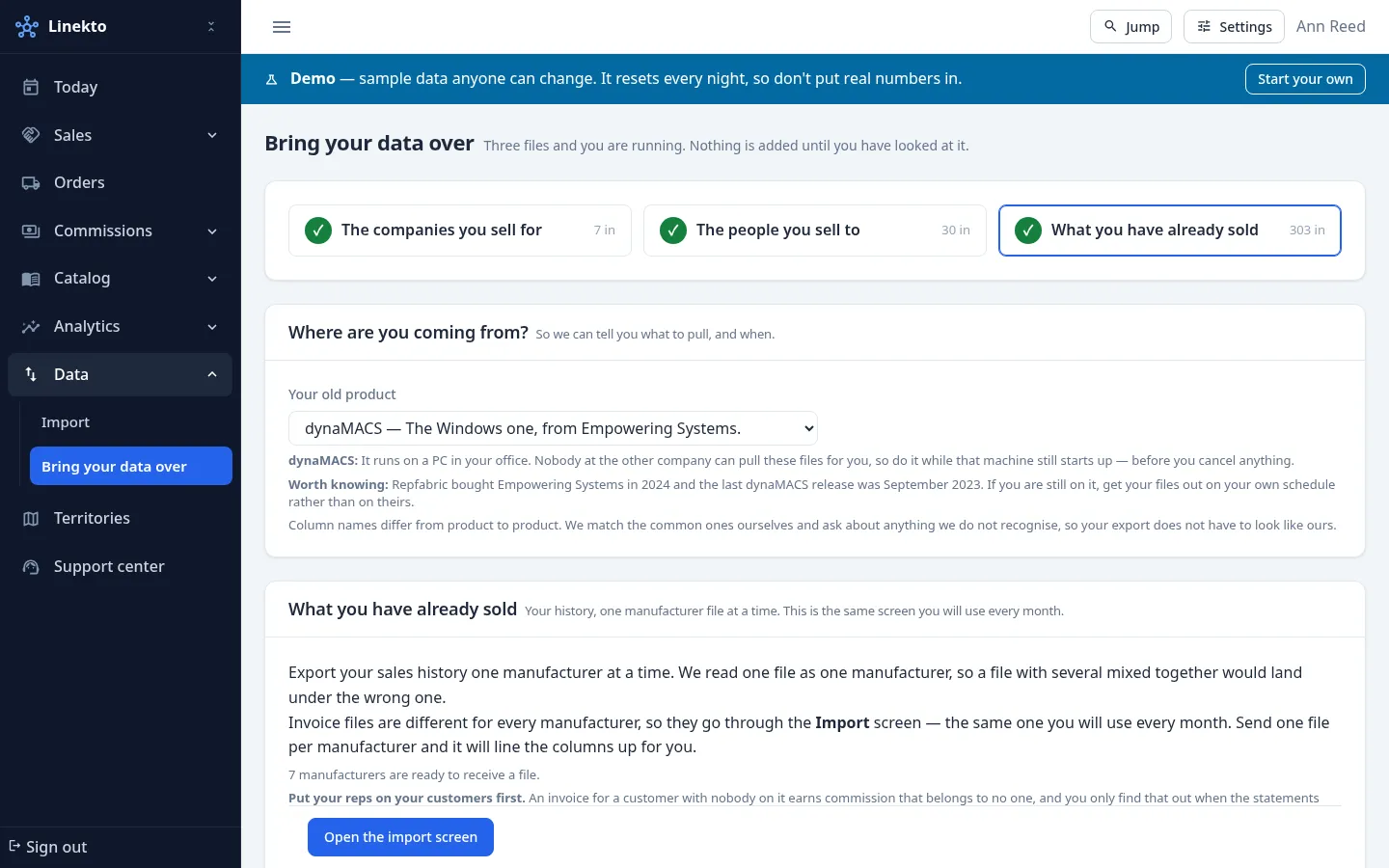
Bring your history over
You are coming from somewhere. That part is in the product, not a project you schedule with us.
Upload several spreadsheets at once — invoices, customers, products, rates.
We guess which column is which, and you fix what we got wrong.
See every row that will go in, and every row that will not, before you commit.
Totals are checked against the file you uploaded, so you know nothing went missing.
Undo a whole batch in one click if it went in wrong.
Record the work
Orders, manufacturer invoices, visits, quotes, jobs out to bid. The things that pile up between the first of the month and the last.
Type an invoice with the fewest fields that make sense, and keep typing — the form remembers what stays the same down a stack.
Copy the previous line with one key when fifty invoices differ by two fields.
Orders, back orders and partial shipments tracked against what was ordered.
Visits, calls and follow-ups logged from a desk or a phone.
Work out what you earned
Rates by manufacturer, then the exceptions — by customer, by product family, by anything the contract actually says.
Default rates per manufacturer, with exceptions that override them.
Multi-level splits: the rep who sold it, the rep whose territory it shipped to, sub-reps and house accounts.
Every number shows where it came from, so a rep asking "why is this figure lower" gets an answer instead of an argument.
Chargebacks when an order is returned or cancelled.
Match the checks
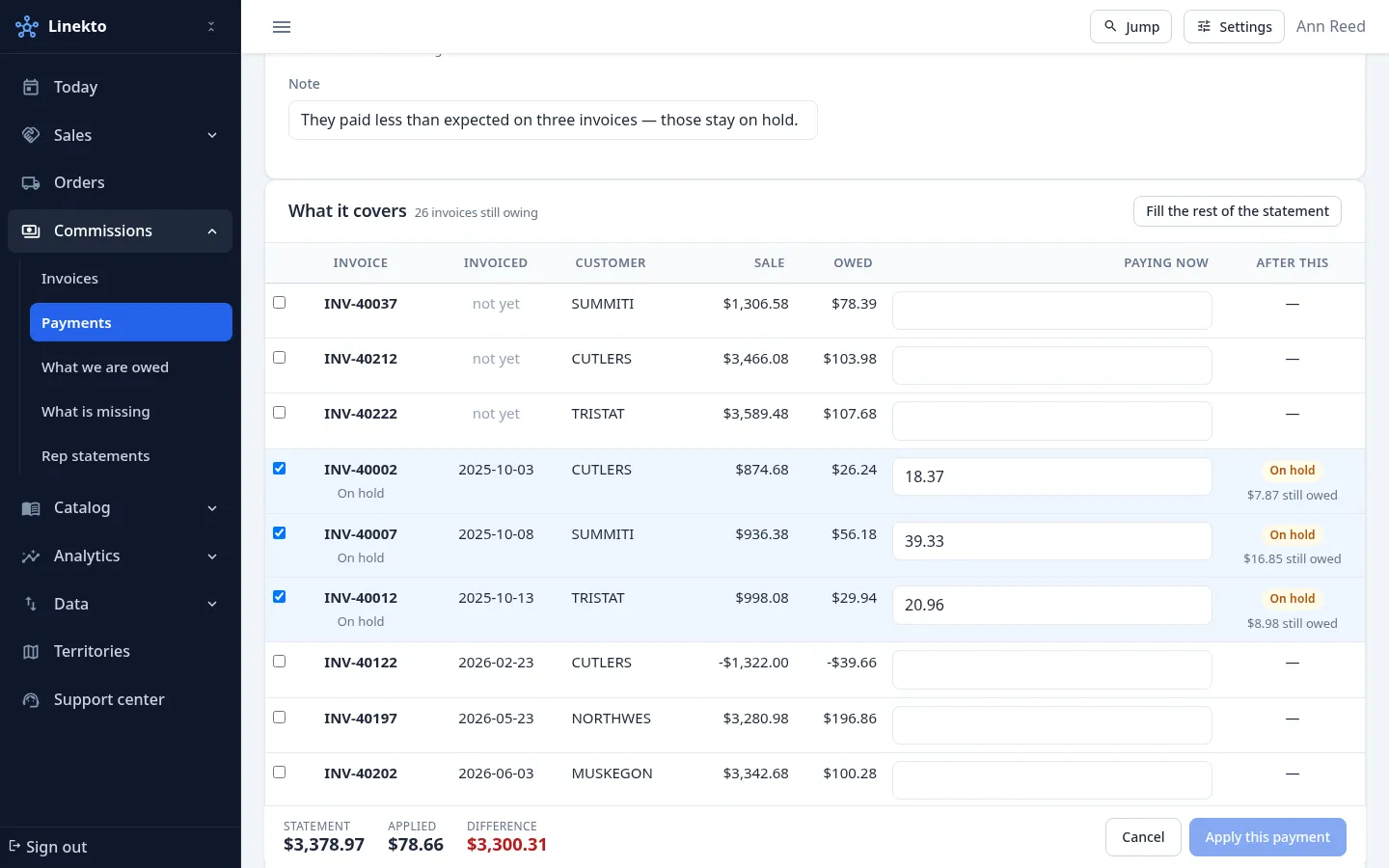
The screen this product exists for. A manufacturer sends one payment for forty invoices and it is short. Which line is wrong?
Apply one payment across many invoices, watching the difference as you go.
Hold back the lines that do not add up instead of forcing the total.
Short payments and deductions recorded against the invoice they belong to.
Nothing is closed until the difference is zero or you say why it is not.
Pay the reps
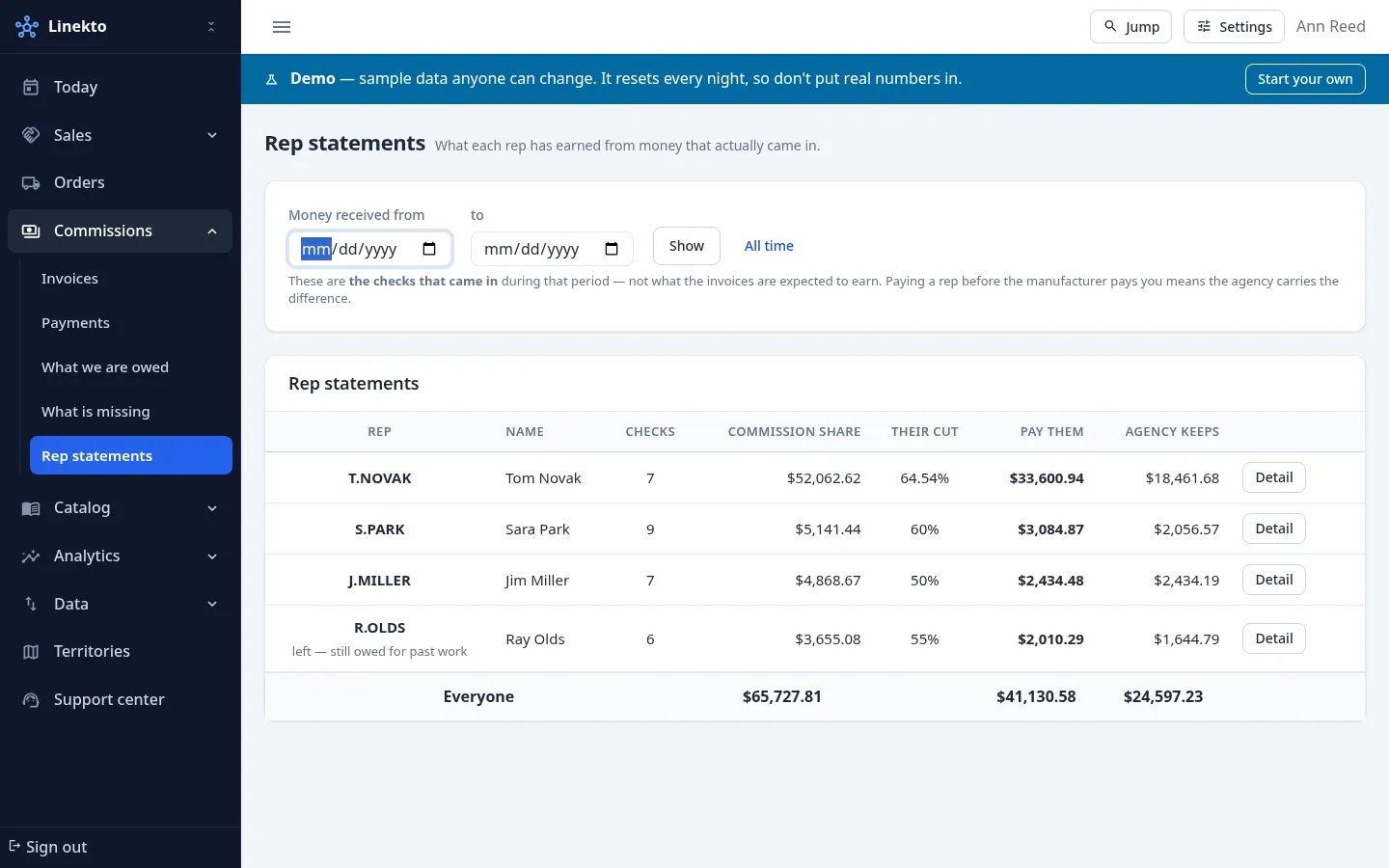
Statements built from what was collected, not from what was invoiced. The difference is the whole job.
Rep statements for a period, with every line traceable back to an invoice.
Draws and advances carried and recovered.
Payout files for the bank, or a list you can work from.
A rep can open their own statement — they do not have to ask for it.
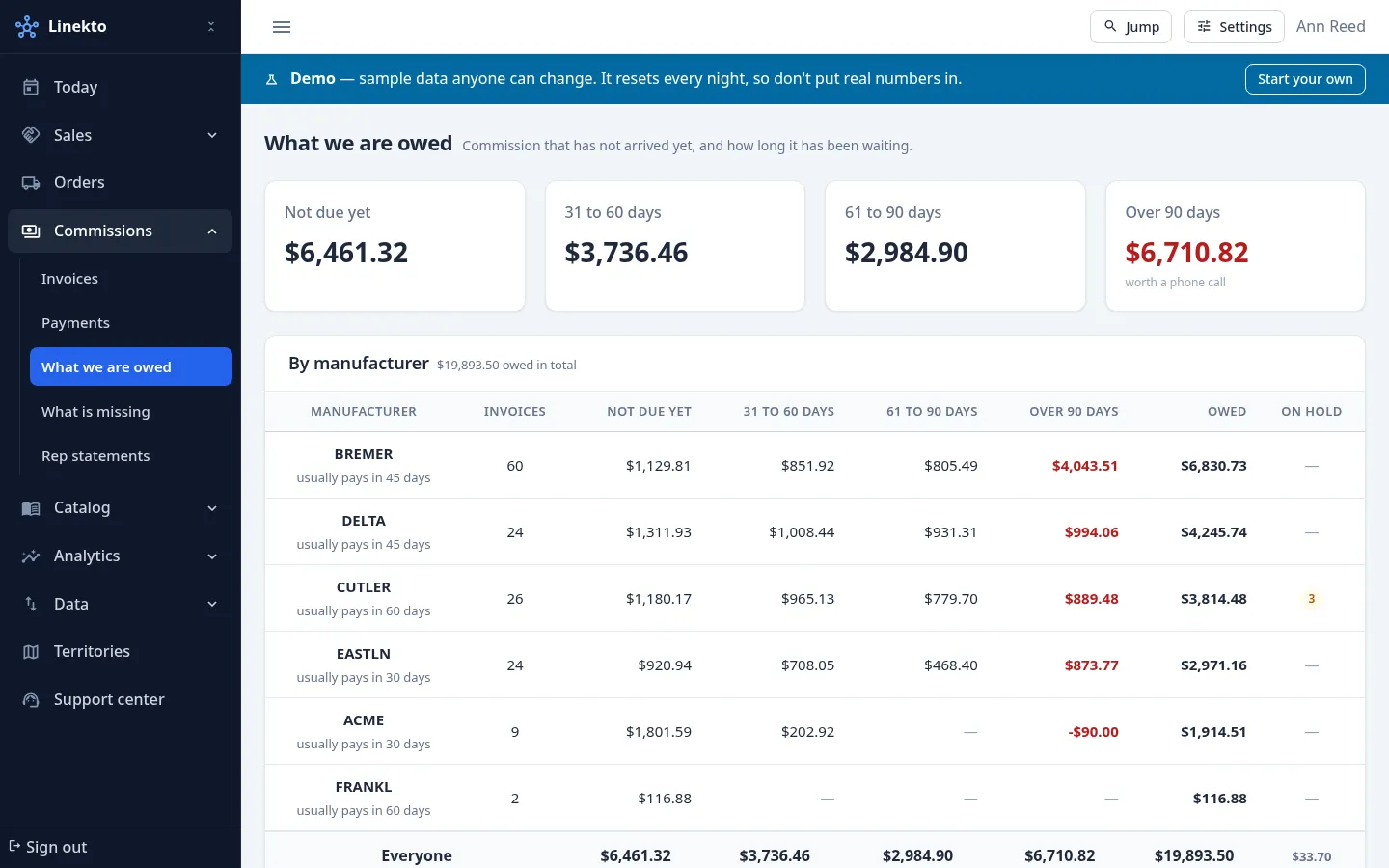
See it, and find what is missing
Two reports nobody runs by hand: the same sales by shipped month and by paid month, and the commission that quietly never arrived.
Shipped month and paid month, side by side. Both numbers are real and they differ.
Commission aging — how long the money has been owed to you.
Orders that shipped with no commission behind them, surfaced instead of searched for.
Drill from manufacturer to rep to customer to product, and export any of it.
And on the phone, between calls
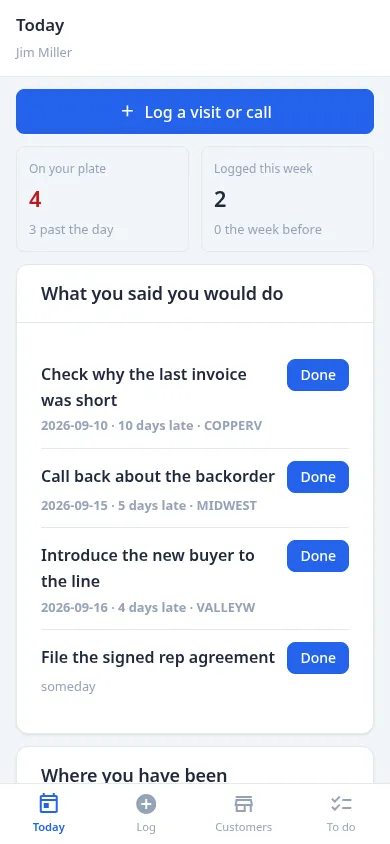
A separate screen for the people who are out all day. Not the whole product shrunk down — the three things you actually do standing in a car park.
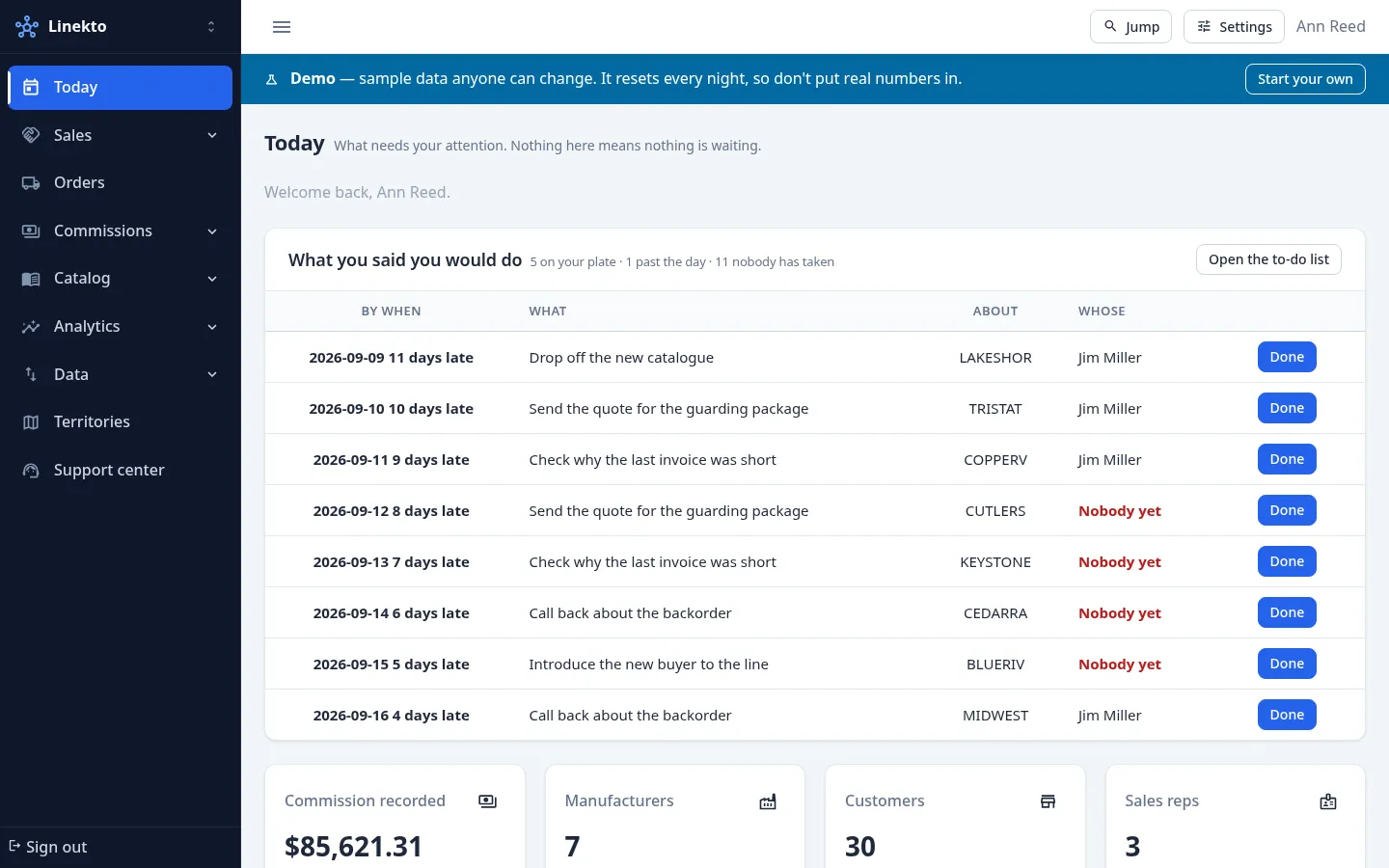
What you said you would do
What is on your plate today and how much of it is past the day. Mark one done with a thumb, without opening a laptop that evening.
Log a visit before you pull away
One big button on every screen. Pick the customer, say what happened, set the next step. The ones you call most are at the top of the list.
Look a customer up on the way in
A few letters finds them. What they buy, who you spoke to last time, and what is still owed — before you walk through the door.
Add it to the home screen
It installs like an app and opens full screen. There is nothing to download from a store, and nothing to update.
A rep sees their own numbers
Field reps get their own customers, their own visits and their own commission. Not the agency's book.
It says so when the signal goes
The screen still opens with no bars and tells you plainly that nothing will save until you are back. It is not an offline app — we would rather say so than lose what you typed.
Same bones, different trade
Agencies differ at the edges, not in the middle. Everyone has principals, commission statements, splits and money that has not arrived. The parts you do not need are switched off.

Industrial, safety and tool
Fasteners, PPE, cutting tools. Long catalogues and a lot of small invoices.
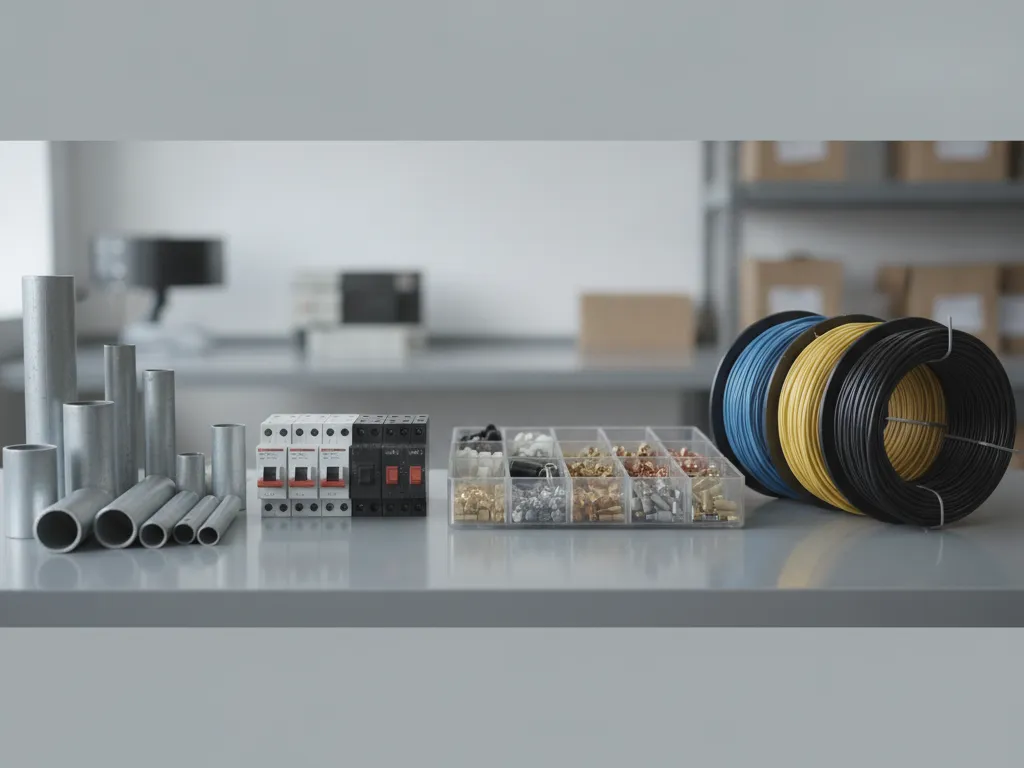
Electrical and electronic
Distributor sell-through, design registrations and special pricing.

Construction products
Jobs out to bid, takeoffs, submittals and change orders.
Coming from something else?
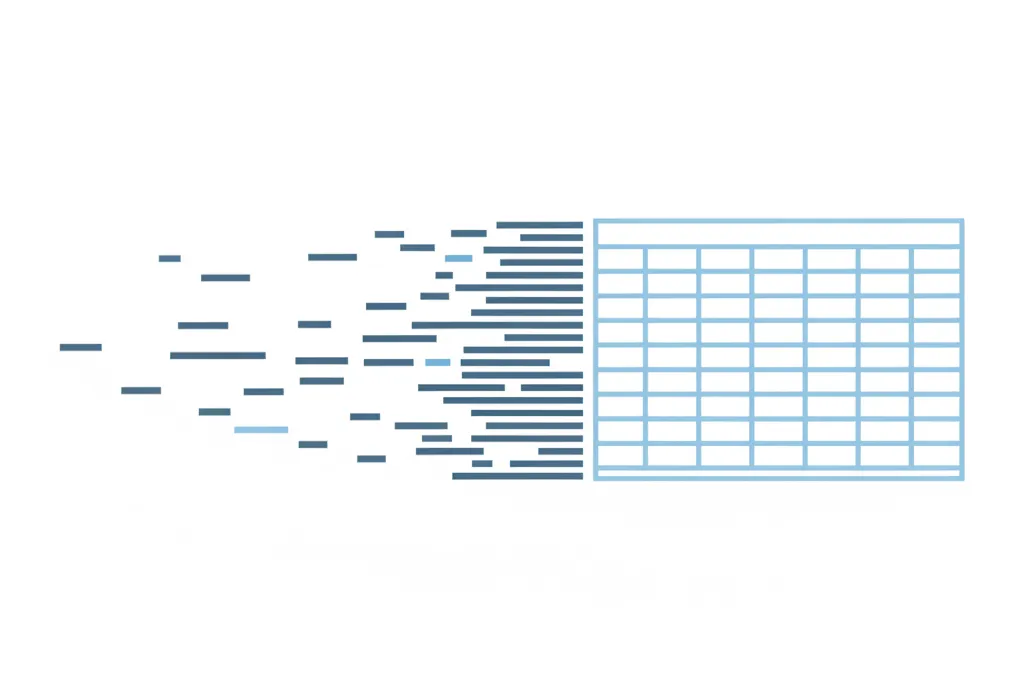
Most agencies are. We wrote a page of instructions for each of these — which screens to export from, and what to do it in what order.
dynaMACS
The Windows one, from Empowering Systems.
RPMS
The one with the big report engine.
MRSware
One product for the whole agency — installed and web both.
Repfabric
Cloud, built around email and mobile.
Flow RMS
Cloud, CRM and ERP in one.
Excel or Google Sheets
No old product — you keep it yourself.
What we have not built
Other systems in this market do these. We do not, yet. You would find out in week one anyway.
Outlook and Gmail inside the product
Voice-to-text visit notes
Working with no internet connection
Open it and look
The demo is a working agency with sample data. No form, no call.